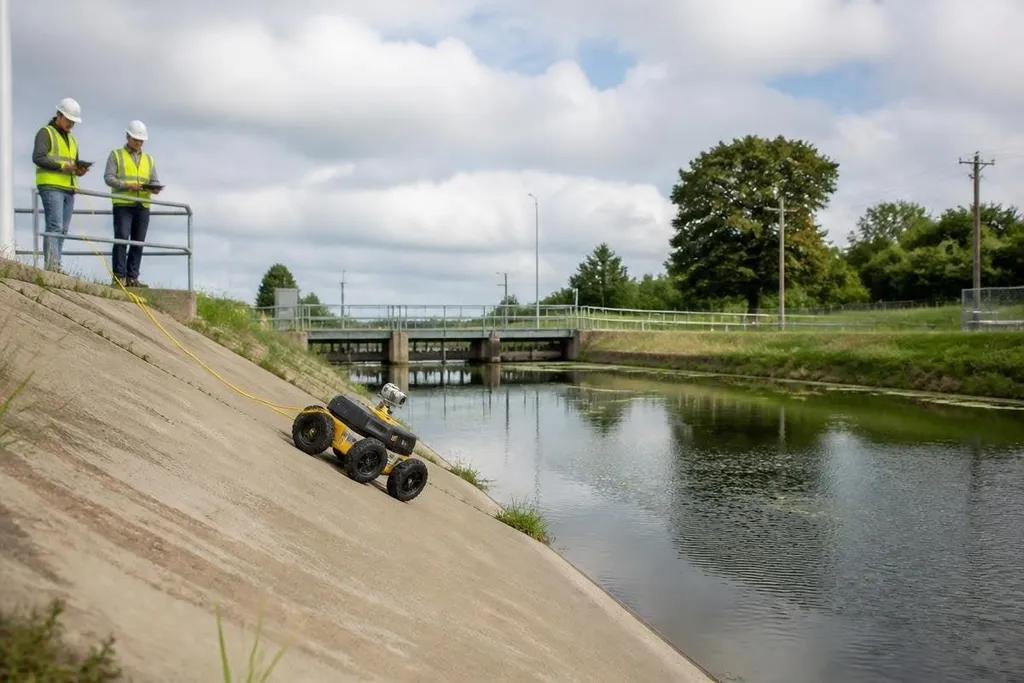
Environmental robots can inspect, monitor, sort, clean, or collect data in places that are costly or unsafe for people. The business opportunity starts when a company can name the task, the buyer, and the cost of doing it today.
- Inspection work: robots can gather site data where access takes time or puts staff at risk.
- Cleanup work: machines can handle repeat tasks that need long hours in the same area.
- Monitoring work: sensors can record conditions over time instead of relying on occasional visits.
Start with the task, not the robot
A company buying an environmental robot is buying a result. That result might be a checked drainage channel, a sorted waste stream, a mapped crop field, or a record of water quality. The robot matters only when it changes the cost, speed, safety, or quality of that work.
This points to several possible buyers. Waste operators may pay for sorting or site checks. Energy companies may need inspection around large assets. Farms may use machines to watch crops or remove unwanted plants. Public agencies may need regular data from land, water, or coastal areas.
These are business leads, not proof of demand for a specific product. The first question is simple: who already pays people or contractors to do this job? If nobody has a budget for it, better autonomy won't fix the sale.
Where the money can come from
Environmental robotics companies can earn money in more than one way. They can sell hardware, charge for robot time, offer inspection reports, or combine equipment with a service contract. Each model places a different burden on the company making the robot.
A hardware sale brings revenue when the customer buys the machine. The customer then takes on training, repairs, software updates, and daily operation. A service model keeps those jobs with the robotics company, but it also means the company must manage transport, staff, batteries, spare parts, and site access.
Data may be the part a customer values most. A robot that records images, measurements, or locations can support a report that helps a manager plan repairs or prove that a site was checked. That data has a business use only when it fits an existing decision and arrives in a form the buyer can act on.
Teleoperation means a person guides the robot from a distance. It can help when full autonomy fails around mud, changing light, loose waste, dense plants, or unexpected objects. The trade-off is labor cost: a robot that needs one operator for every machine may shift work rather than remove it.
That labor question changes the sale: a buyer needs to compare the robot’s task, operator hours, test site, and date with the company’s claim. Environmental robotics reporting can put those details together before you price a service or assess the limits below.
The limits that shape a real sale
Outdoor work gives robots problems that are hard to reproduce in a clean test area. Rain can affect cameras and electronics. Dust can enter moving parts. Uneven ground can slow a wheeled robot or force a tracked design. Plants, rubbish, ice, and shallow water can change the job from one hour to the next.
Those conditions affect the contract. A customer may ask who pays when the robot stops, how quickly a technician must arrive, and what happens when the robot misses an object. Insurance, permits, worker safety rules, and data ownership can also decide whether a pilot becomes regular work.
The largest open question is usually the cost of supervision. A machine may complete the physical task while a person watches video, checks alerts, moves it past obstacles, and reviews its data. Until that labor is measured across normal working days, claims about savings remain unproven.
A practical buying check
Use these questions before funding a pilot:
- Name the buyer: identify the person who controls the budget and signs the contract.
- Price the current job: include staff time, contractor fees, travel, equipment, and repeat visits.
- Set the robot’s boundary: write down the terrain, weather, shift length, payload, and network limits.
- Count human work: record setup, remote control, cleaning, charging, repairs, and data review.
- Choose one result: measure a finished inspection, collected load, accepted report, or reduced visit time.
- Set a stop rule: decide the cost or performance level that ends the trial.
A useful pilot should compare the robot with the current method on the same site and task. That comparison needs a fixed time period, a named measure, and a record of every human intervention. Without those details, a demonstration can show movement without showing a business.
I'd start with a repeat task that already has a clear invoice and a safe way to measure the result. Environmental robots can find paying work, but the first sale will come from reliable task performance, not from autonomy alone.